
How Southbrook Reengineered a 60+ Item Restaurant Menu to Improve Profitability
Client Success Story | Restaurant Menu Engineering & Operational Optimization
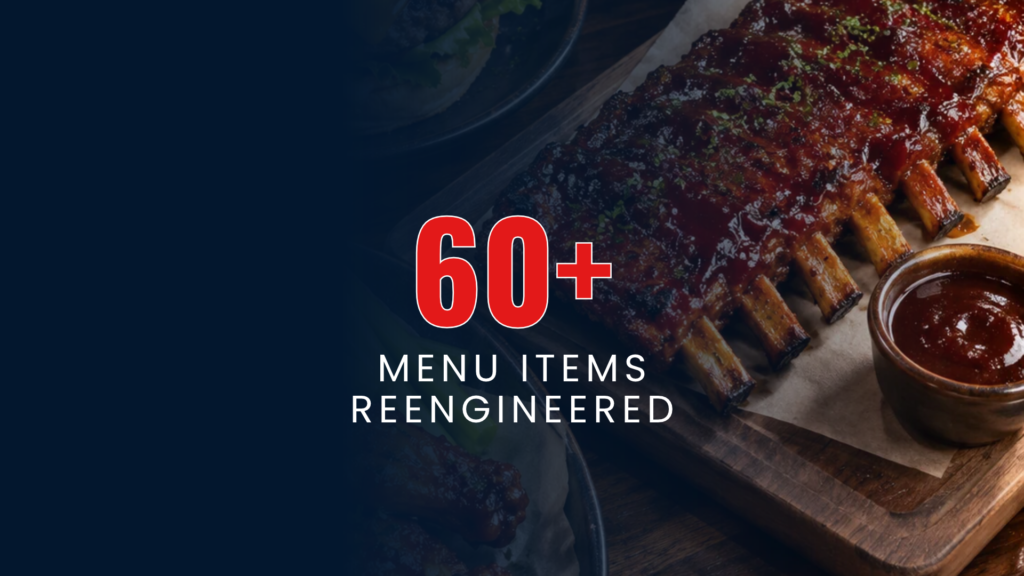
Southbrook reengineered a menu of more than 60 items for an established casual dining restaurant chain, improving menu structure, food cost controls, purchasing efficiency and operational consistency.
Food Cost Analysis
Evaluated 55% actual food costs and opportunities for improvement.
Menu Engineering
Standardized recipes, portions and menu execution.
Operations & Training
Developed manuals, training systems and kitchen procedures.
Procurement Optimization
Streamlined ingredients, SKUs and purchasing processes.
A large menu can create serious challenges for restaurant profitability. Too many ingredients, inconsistent portion sizes and inefficient purchasing can drive up food costs, even when sales are strong.
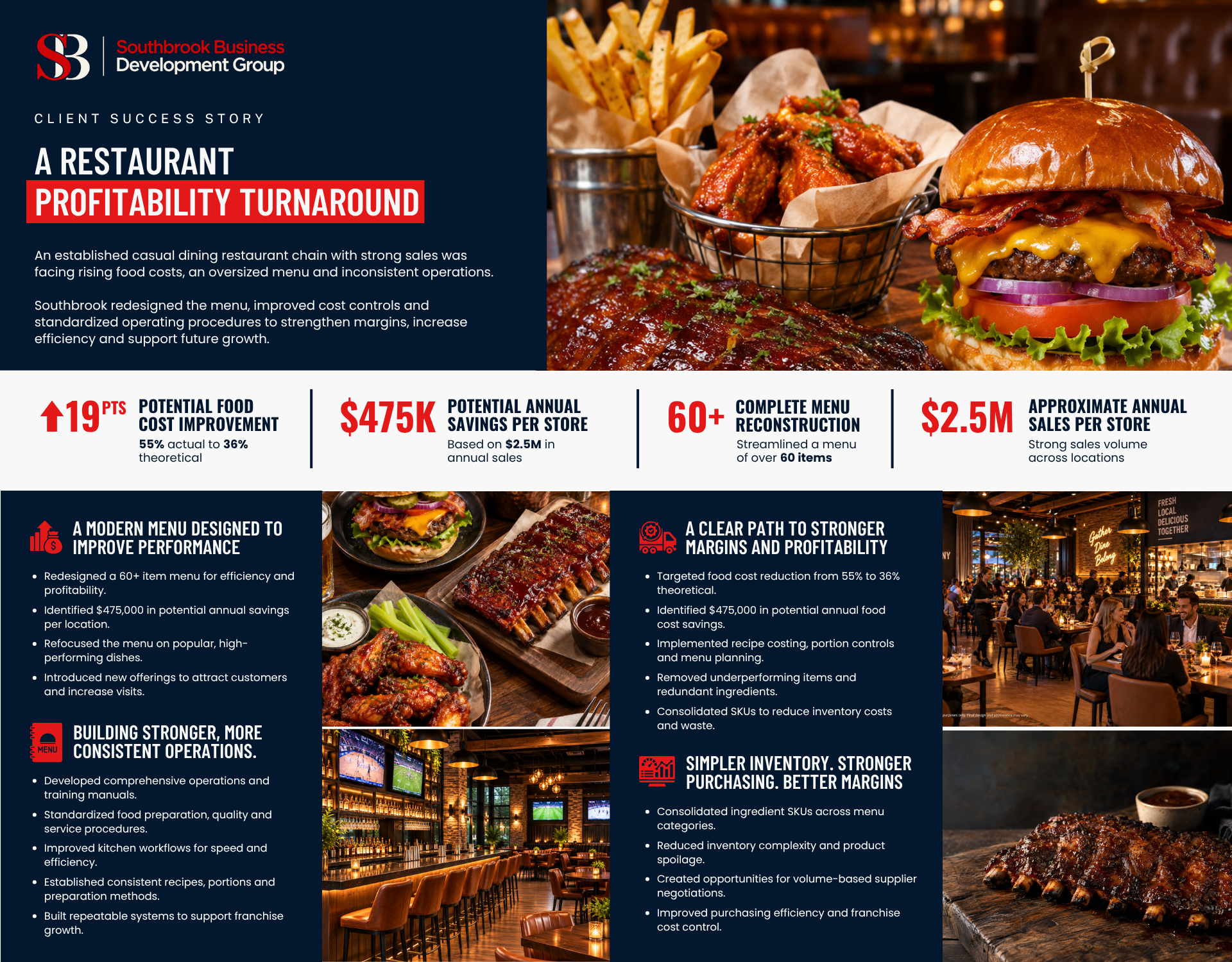
Southbrook Business Development Group worked with an established casual dining restaurant chain generating approximately $2.5 million in annual sales per location, but facing food costs of 55%.
The team completed a comprehensive menu reconstruction, introduced recipe costing and portion controls, streamlined purchasing and developed standardized operating procedures to improve efficiency and strengthen restaurant operations.
The Challenge: Strong Sales, High Food Costs
The casual dining restaurant chain had strong sales and an established customer base. However, rising food costs, a menu containing more than 60 items and inconsistent operating procedures were affecting efficiency and putting pressure on profitability.
With actual food costs reaching 55%, the business needed better control over purchasing, recipes, portions and daily operations.
A large menu also increased ingredient requirements, inventory complexity and kitchen workload.
Southbrook focused on simplifying the menu, strengthening cost controls and creating more consistent operating systems across locations.
1. Menu Engineering and Culinary Innovation
Southbrook completed a comprehensive reconstruction of the restaurant’s menu, focusing on product performance, operational efficiency and customer appeal.
The work included:
Reengineering a menu containing more than 60 items
Refocusing the offering on popular, high-performing dishes
Removing unnecessary menu complexity
Introducing new products to attract customers
Improving menu structure and product consistency
The redesigned menu created a more focused offering while supporting more efficient kitchen operations.
2. Food Cost Optimization and Portion Control
Food cost analysis identified a significant gap between the restaurant’s 55% actual food cost and a 36% theoretical target.
Southbrook introduced stronger controls over ingredients, recipes and food preparation.
The work included:
Implementing detailed recipe costing
Standardizing portion sizes and preparation methods
Improving ingredient usage and menu planning
Removing redundant ingredients and underperforming items
Consolidating SKUs to reduce inventory costs and waste
The analysis established a 19-percentage-point theoretical food cost improvement opportunity.
Based on approximately $2.5 million in annual sales per restaurant, this represented an estimated $475,000 annual savings opportunity per location.
This was an identified opportunity, not a confirmed achieved reduction. The operational improvements created a framework for working toward stronger food cost performance.
 FREE DOWNLOAD
Download the Full Case Study
See how Southbrook reconstructed a large restaurant menu, strengthened food cost controls, streamlined purchasing and standardized operations across locations.
Download Case Study ↓3. Restaurant Operations and Staff Training
Consistent food preparation and operating procedures are essential for maintaining quality and controlling costs across multiple locations.
Southbrook developed comprehensive operations and training systems to improve execution and reduce inconsistencies.
The work included:
Developing operations and training manuals
Standardizing food preparation and service procedures
Establishing consistent recipes and portion standards
Improving kitchen workflows and efficiency
Creating repeatable systems to support franchise growth
These systems established clearer operating expectations and a more consistent approach to staff training and daily operations.
4. Procurement and Inventory Optimization
An extensive menu can increase purchasing complexity, ingredient requirements and opportunities for waste.
Southbrook reviewed the restaurant’s purchasing processes and streamlined ingredient management to improve efficiency.
The work included:
Consolidating ingredient SKUs across menu categories
Simplifying purchasing and inventory requirements
Reducing opportunities for product spoilage
Identifying volume-based supplier negotiation opportunities
Improving purchasing procedures and cost control
The changes reduced unnecessary operational complexity and strengthened the restaurant’s purchasing processes.
The Outcome: Stronger Systems for Restaurant Profitability
Southbrook completed a comprehensive menu and operational restructuring designed to address high food costs, purchasing inefficiencies and inconsistent restaurant procedures.
The project delivered:
A reconstructed menu containing more than 60 items
Standardized recipes, portions and preparation methods
Comprehensive operations and training manuals
Streamlined purchasing and ingredient management
Improved kitchen workflows and operating procedures
The food cost analysis also established a theoretical improvement target of 36%, compared with the restaurant’s original 55% actual food cost.
By combining menu engineering, procurement improvements and operational standardization, Southbrook developed a more consistent operating framework to support cost control and future growth.
The project highlights how restaurant profitability depends not only on sales, but on the systems that manage food costs, purchasing, preparation and daily execution.
Your Restaurant Is Busy. But Is It Profitable?
Strong sales don't always mean strong profits. High food costs, inefficient purchasing and inconsistent operations can put pressure on your bottom line. Southbrook helps restaurant owners identify costly inefficiencies and build practical solutions to improve performance.